Learn enough Japanese. (Enough. Not the whole language.)
This sounds obvious. If you’re going to another country, you should learn some of the language. Japanese is a highly complex language that you probably won’t pick up quickly, so if you don’t have gobs of time, learn the basics. Travis put this list together for me: Japanese Language – Sheet1
The words I ended up using every day, multiple times a day:
- Arigato gozaimasu: thank you very much
- Sumimasen: excuse me
- Hai: yes
I never used “doku des ka” (which is how you ask where something is) but I was glad to know it.
Get a local or semi-local guide if you can, or talk to people who have lived there.
I was lucky enough to travel with someone who had lived in Japan for some time prior to coming back for a visit. Travis already knew the train system, knew the city, knew the food, knew where to go, etc. I got cultural tips and largely followed his lead for the first 36 hours of the trip, until I felt comfortable on my own. This was a ginormous help. If you don’t have someone similiar with whom you can travel, talk to expats. Look up expat blogs. Even look up coworkers who live in that country!
Trains: Download the Hyperdia app for your iPhone or Android.
A lifesaver of an app that gives you Tokyo train routes and directions, all in English. On the first screen you’ll enter your starting and ending stations, as well as your desired departure time or arrival time. Hyperdia will spit back out a number of routes from which you can choose.
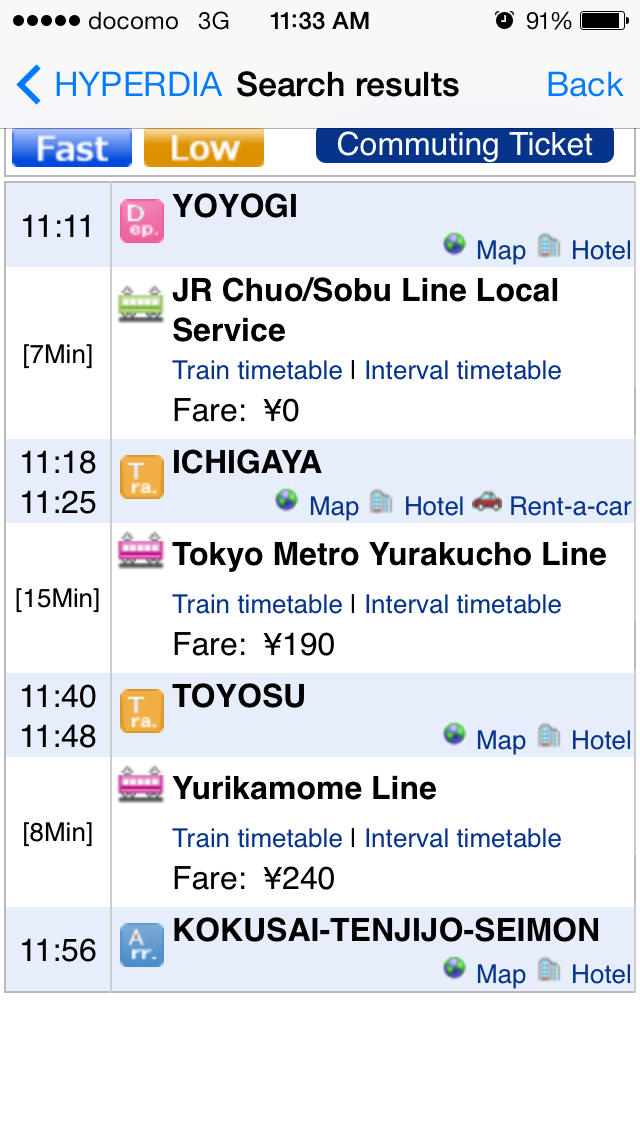
A few notes on Hyperdia and trains in general:
- Once you get a route you like, take a screen shot. Hyperdia does not do well at taking you back to your route if you leave the app mid-trip.
- Green train symbols mean the JR lines
- Pink train symbols mean the Toyko Metro
- Either the Metro or the JR can be above or below ground, but changing from one to the other usually means a bit of a walk out of one station and to another.
- As with traveling anywhere: don’t try to be smarter than the signs. Follow the signs in the trains/subway to get to your lines, etc. If you don’t see the sign you need, look again.
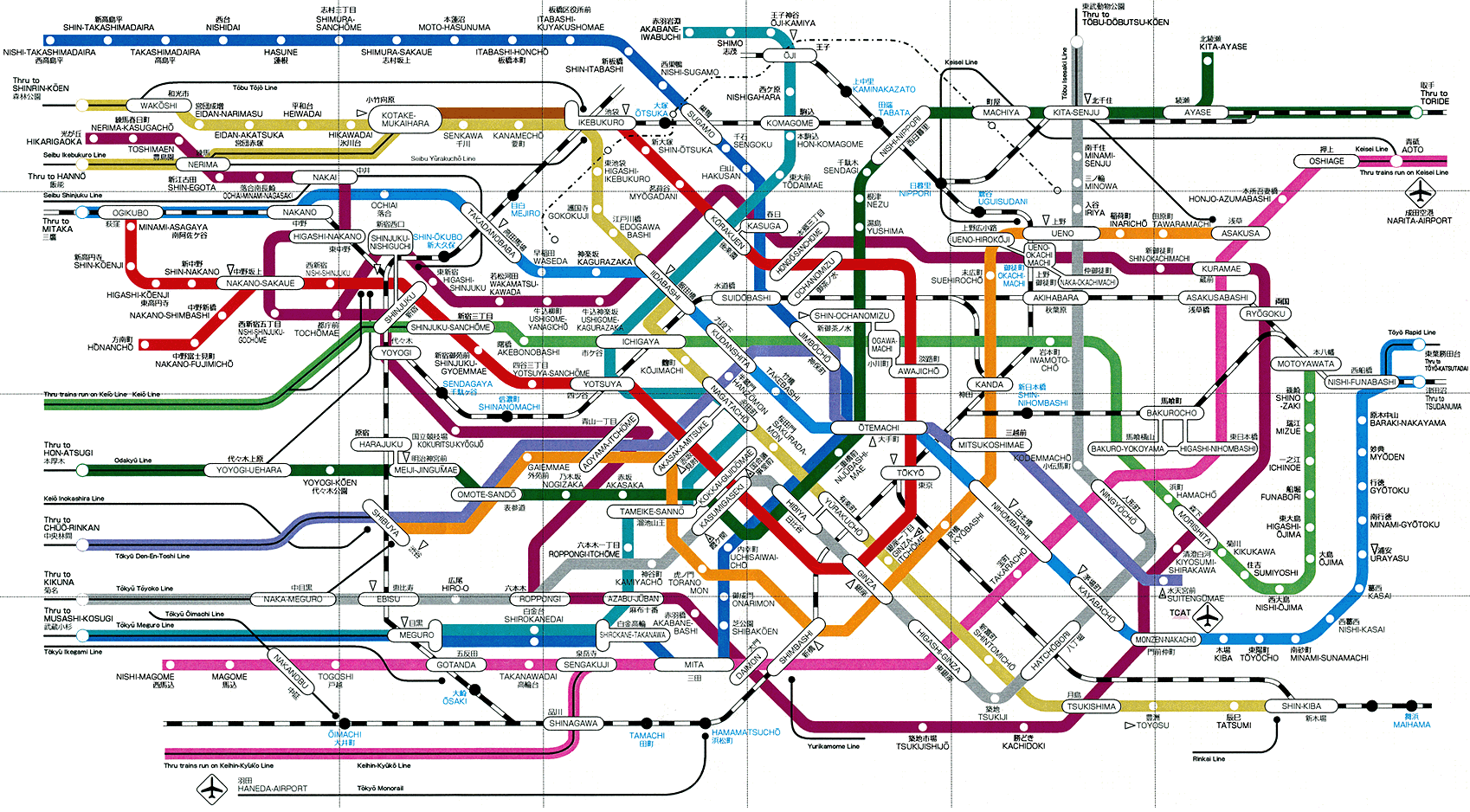
You should also print off the following two maps:
Cell Phones, Data, Messaging, etc.
At the risk of sounding like a corporate shill, T-Mobile has the best international plan I’ve seen. Free unlimited data and messaging, with calls at twenty cents a minute. This, at no additional charge to my unlimited data, messaging, and minutes plan here in the US — which incidentally is $30/month less than I was paying with Verizon. This is ridiculously good, and worked out really well in Japan. Both Travis and I are on T-Mobile, and we were on NTT Docomo’s network with 3G at all times, plus the option to upgrade to 4G for a fee. Neither of us took the upgrade option, because 3G was sufficient. We didn’t have to do anything more than take our phones out of airplane mode when we landed in Tokyo — everything just worked.
The downside to T-Mobile is that it’s not Verizon or AT&T, so your coverage in the US is not as consistent. I can tell you exactly where the signal drops in Denver, ever single time. But, it’s good in major urban areas (Chicago excepted) so if you’re planning international trips, consider T-Mobile. And if you do that, check out RootMetrics. It’s a site that provides a great way to see what cell phone providers are best for your local area and for areas to which you often travel in the US.
Ordering food.
Unless you are fluent in Japanese, or at least fluent in culinary Japanese, you’ll inevitably feel S.O.L. at some point when it comes to getting food, even if you’re food-adventurous. But believe it or not… you’re not.
If you have a menu that is entirely in Japanese:
- Accept that you won’t entirely know what you’re eating.
- Order only what is pictured on the menu. There are a lot of pictures, at least at the places we went.
- If you don’t want everything pictured, use your hands to block out what you don’t want, and point to what you do want. Say “hai” (yes.) (I did this a lot.)
- Hope the server understood, and eat what they bring back.
Alternatives:
Some restaurants have English menus, which they will bring to you usually without your asking for it. Because hey, if you’re a blonde white girl like me or a tall white guy like Travis, it’s pretty obvious you’re not Japanese, so they’ll make a reasonable assumption.
Go to a place with a conveyor belt.
Helpful links:
yokotatravel.com: http://yokotatravel.com/
- Yokota is a US Air Force base outside of central Tokyo in Fussa, and this is a site put together by the YOSC (Yokota Officer Spouse’s Club.) It’s all in English.
- I wish I would’ve seen this prior to traveling to Japan!!! There are places that would’ve made Tachikawa beautiful, like an American-style brewery that serves California microbrews. Even seasonal ones.
 I Like To Go Places